Computational Fluid Dynamics (CFD)
1. Condensation Mechanism In Heat Exchanging System
Condensation is a heat transfer process, and in a multiphase system, heat exchange between different phases becomes crucial, impacting the rate and location of condensation. The “evaporation-condensation model” is a physics-based mechanistic approach available in both the mixture and Eulerian multiphase models. In tackling the challenge of limited computational power, by strategically implementing an adaptive time-stepping method, convergence in the continuity equation is successfully achieved.
2. Shell and Tube Heat Exchanger Design and Analysis
The outlet temperature of each fluid depends on the inlet temperature, mass flow rate, the amount of heat exchanged, and other factors. TEMA specifications guide the design. Detailed calculations, SolidWorks (CAD and Drafting), and Fluent (CFD Validation) make up the workflow.
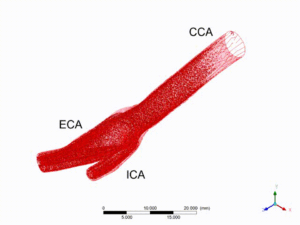
3. Blood Flow Analysis of Bifurcating Arteries, Design of Stent. (Unpublished Research Study)
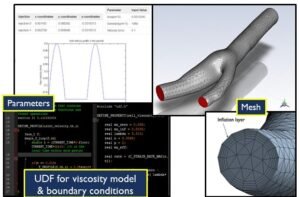
We know the behavior of the blood flow is Non-Newtonian. User Defined Functions (UDFs) implement realistic time-varying boundary conditions to mimic the pulsatile nature of the blood flow. Wall shear stress (WSS) exerted on the walls of the blood vessel is found.
4. Effectiveness of Air Curtain
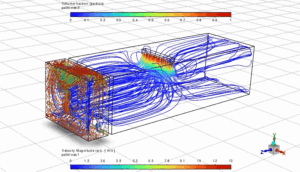
An attempt to model the effectiveness of an air curtain, based on experiments conducted by Muhammad Jahanzaib in his study, “Analyzing the Effectiveness of Air Curtains in Reducing Particulate Matter Generated by Human-Induced Slipstream.”
5. Valve Design
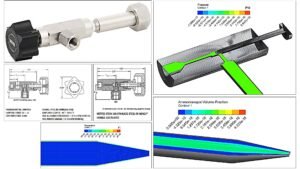
This valve and nozzle design involved selecting the valve based on design parameters, reverse-engineering the geometry from the manufacturer’s technical drawings, and solving multiphase CFD for ammonia flow analysis.